Duffley Law
A case study on how Duffley Law, an estate planning law firm based in Texas, used Google and video content to win — and how it can power its next phase of growth via a focused content strategy.
Year
2026
Background
Duffley Law has an interesting origin story. Its founder, Jack Duffley, is a former real estate attorney in Chicago Big Law. After leaving Big Law in 2023, he founded Duffley Law, an estate planning and probate practice focused on helping Texan families navigate estate and succession issues painlessly. Jack also does YouTube on a part-time basis, where he breaks down his journey every month as he works toward achieving a $1 million net worth. A quick aside, the content is great and transparent. If you’d like to take a peek, you can do so here.
Before we move forward, a quick disclaimer: I am not currently affiliated with nor do I work for Duffley Law. The following information merely represents my thoughts based on my expertise and personal observations of Duffley Law’s publicly available content. Let’s dive in.
Target Clients
Duffley Law primarily serves individuals and families in Texas, helping clients with estate planning, probate, and real estate. Its website notes that the firm also has a presence in Illinois, where it offers estate planning services.

How do individuals and families find attorneys?
With Duffley Law’s target audience clarified, the question then becomes, how do these clients find attorneys? For individuals, the answer is often a combination of referrals from friends and family, referrals from other attorneys, and online searches. On the first and second point, firms get referrals by providing excellent client-centred service and letting word of mouth from past clients do the talking.
While in the past, referrals accounted for the majority of a firm’s book of business, recent research by Martindale-Avvo shows that number is increasingly dwindling. As of 2023, when legal consumers were asked how they secured an attorney, only 4 in 10 said they did so via a referral. Martindale-Avvo’s research notes that 86% of respondents use online resources when handling their legal matter, and 70% dive into online content before deciding to engage with an attorney. This brings us to the third way individuals use to find attorneys: online research.
On this front, great reviews, solid SEO, and a decent digital footprint are crucial. As clients research attorneys before committing to a hiring decision, attorneys with strong reviews speaking to technical expertise and professional care (the second increasingly important in the emotion-laden practice area Duffley Law operates in) and good rankings will beat those without.
How then has Duffley Law fared?
Duffley Law has done three things excellently. It has a clean, professional website explaining what it does, a ton of fantastic Google reviews from past clients, and a decent digital footprint of helpful videos breaking down estate planning and probate.
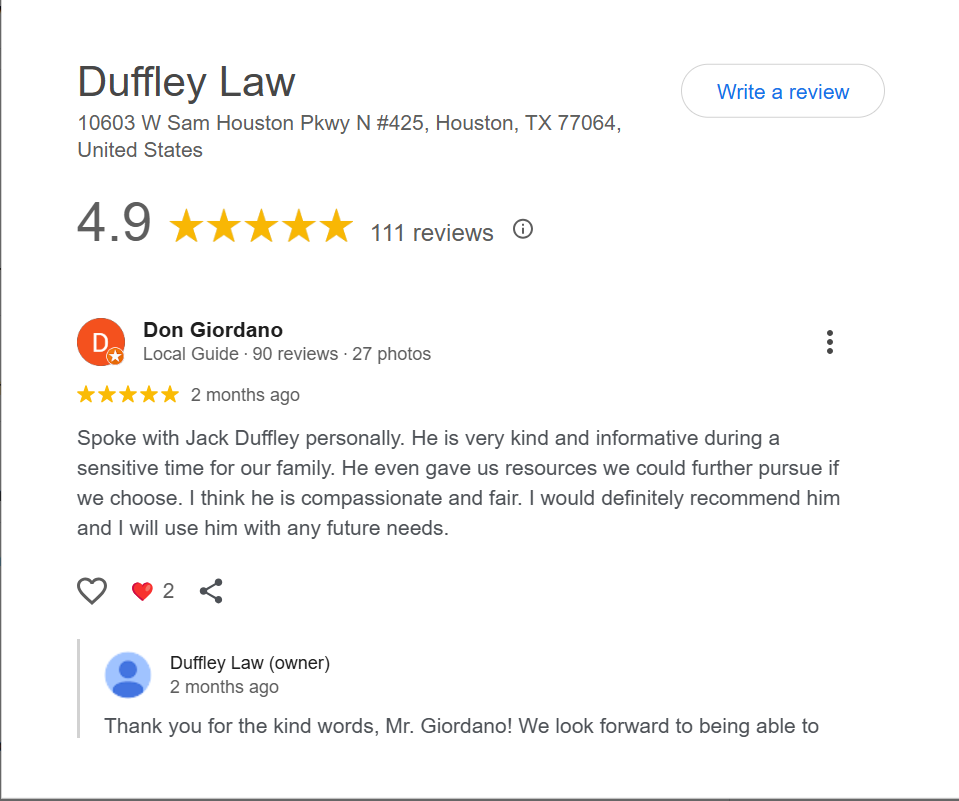
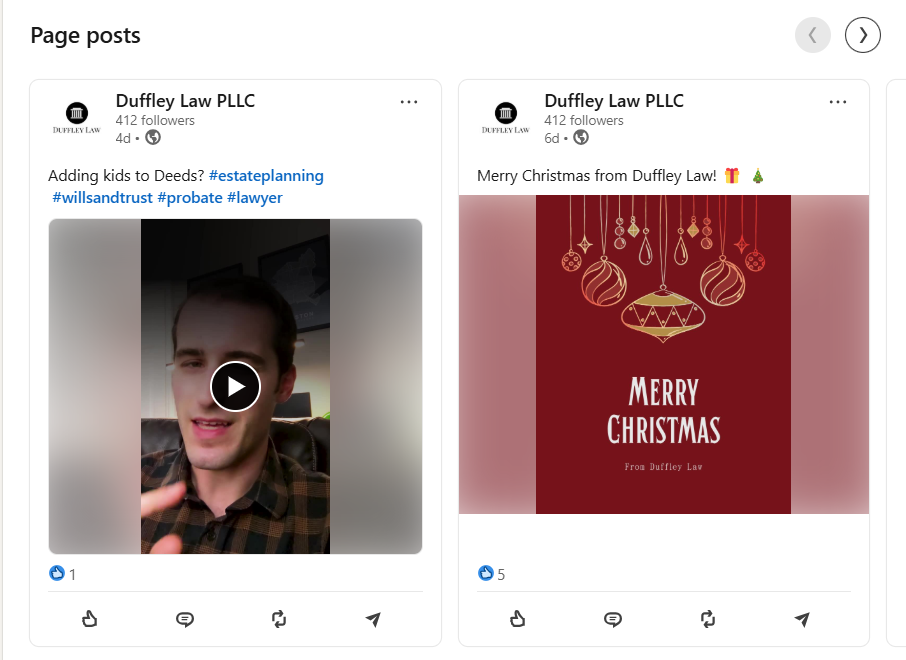
These digital efforts have apparently worked to great effect. Jack reports the firm had a record sales month in January 2026 and is on track to sustain that growth. The videos are resonating due to their educational nature, and the Google reviews continue to serve as reassurance for potential clients looking to engage the firm.
Opportunities for growth
While the firm is already on solid footing, there are a couple of small improvements that could supercharge its growth. First, the firm currently has an inconsistent publishing schedule that fails to capitalize on audience engagement times and misses out on the algorithm gains possible from consistency in content publishing.
Second, the firm currently relies solely on video content. While video content is undoubtedly effective for trust and credibility building, it requires significant commitment both on the part of Duffley Law attorneys in making them and Duffley Law audiences in settling down to watch them. While content types like carousels and statics can easily be skimmed through, videos cannot. This gap misses an opportunity to engage with a broader audience who may be encountering the firm’s content for the very first time and may prefer delivery in a text-first format.
The idea is not to ditch video completely; research shows video remains the single most effective way to reach audiences across different age demographics. The idea is to pair videos with high-converting, text-first content that ensures the firm’s social media continues to convert in times where time to make videos is scarce. Text-first content also provides an opportunity to broadly distribute the firm’s consistently published blog articles via summarized, easily skimmable media. Here’s a quick example of what this would look like, a carousel based on content from a previous Duffley Law video:






The third and final opportunity is that the firm can mix up content pillars to further drive up engagement and conversion rates. While the firm predominantly relies on a single pillar: educational content, mixing this with community-focused initiatives, news alerts, and motivational content ensures the firm consistently drives engagement while building trust and credibility among potential clients.
Conclusion
Duffley continues to do incredible work and is solidly positioned for continued, steady growth over the next few years. With subtle tweaks to its digital strategy, the firm can continue to leverage social media not as an end in itself, but as a means for compounding trust, credibility, and growth.
Ready to scale?
Let’s discuss growing your law firm — and attracting the right clients.